In order for everyone to have fun on our tours and trips, it is important to think about safety. We have extensive experience in leading groups both in Sweden and around the world. Last year, more than 1,300 person tours were cycled.
The most common causes of accidents that we see are.
- Playing with your phone while cycling
- Cycling too close, or overlapping
- Overestimate your abilities.
By thinking proactively and being aware, we can collectively significantly reduce the risks. Ultimately, it is an individual responsibility.
There is no point in staying close, we are not aiming for any particular time or speed. If you feel it is going too fast, let us know and we will adjust the speed rather than you trying to get shelter from what is ahead.
Don't brake suddenly.
A common cause of accidents is when the person in front brakes suddenly, avoid it. Slow down in a controlled manner, signal and pull over. Even if the person behind you has time to react, the third or fourth… person may not.
Distance
The appropriate distance is of course dependent on conditions and habits.
On a narrow and winding single track, the distance must be longer than on a wide road with a hard and firm surface. A good rule of thumb in tight spaces is the three-second rule. One second to react, one second to brake, one second to reserve.
We don't always have to keep that much distance, but sometimes it's necessary, again use judgment and think about safety.
Signaling
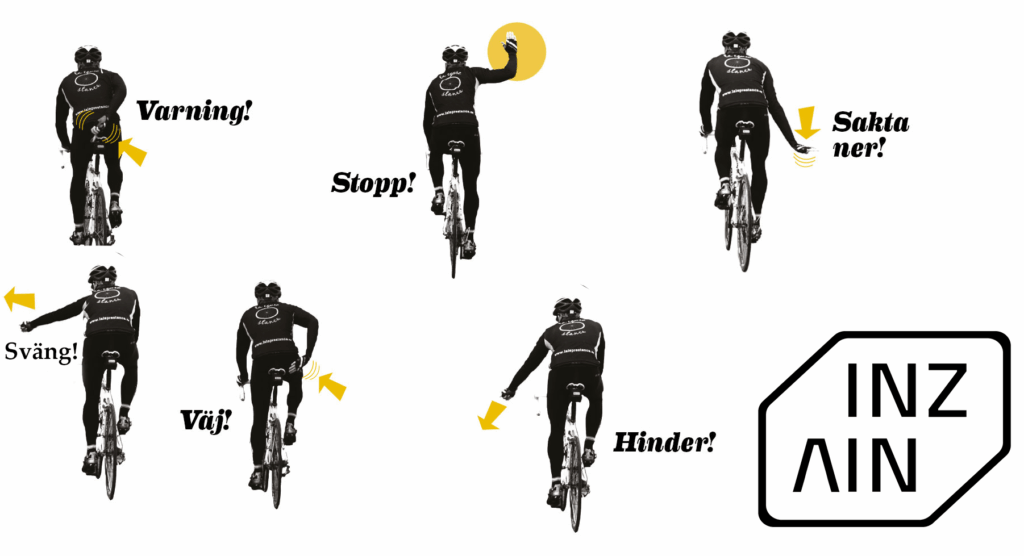
We help each other by warning of dangers. Some things about that are important.
Clarity and repetition. If someone warns about something, make sure to repeat it so that cyclists further ahead or behind get the same warning.
The most dangerous are cars, shout loudly and clearly, repeat backwards or forwards.
If we need to stop, signal to stop with a raised hand.
Do this BEFORE braking, if possible.
Smaller obstacles such as pedestrians, warn by patting your lower back on the side of the obstacle, again repeating backwards.
If we are going to slow down, the leader will make an up and down movement with his hand.
Dangers such as rocks, holes, etc. are pointed out and on the right side. It is not possible to warn about everything so use your judgment.
On gravel, barriers are something to watch out for. Mark them with a movement behind your back on the side (if there is one) where the barrier is and shout “BAM!”
Medical conditions
If you have one, please let the group know and talk about what we should do if something happens.
ICE – In Case of Emergency
It is a good idea to carry contact information for your loved ones in some way so that they can be contacted in the event of an accident. ICE can be stored in a number of different ways, choose the one that works best for you.
If an accident occurs
Emergency measures in the event of an accident
Make sure the entire group is made aware that an accident has occurred and stops to help.
Secure the location.
On the highway: Cyclists at the back of the group warn other road users approaching the scene that an accident has occurred. Prevent anyone from crashing into you.
Off-road: Cyclists at the back of the group keep a lookout and warn other cyclists approaching the scene that an accident has occurred. Prevent someone from running into you and risking further injury.
If you suspect there are serious injuries, provide first aid according to L-ABC while someone else CALLS 112.
If someone has hit their head, there is a suspicion of a neck or back injury. Make sure the person does not move, so that the injury does not worsen. If you are sure that no such injury has occurred and that the location is too unsafe, move everyone off the roadway/path together with the injured person, carefully. Please keep your head stable when moving.
Post-acute considerations
Unless the injury is so serious that an ambulance needs to be called, consider very carefully whether the person should continue cycling the session. If not, ensure that the person gets home in an appropriate manner. Be a good companion, always offer to walk you home. Never let a person cycle home after an accident if you suspect that the person has hit their head or suffered another serious injury.
If a serious accident has occurred, there may be several people who need support afterwards even if you yourself have not been physically injured. It is important to coordinate this so that no one has to go home alone without having received the support that may be needed.
Reporting, investigation and learning
Gear
It's wise to bring some basic items to take care of injuries and accidents.
- 112 App – gives the operator your location automatically
- Waterproof plasters, preferably larger ones.
- Disinfection – wound wipes are good
- Alvedon – Ipren
- Antihistamine – good for insect bites
- Compress
Here is a link to other things that are good to have with you to handle simple repairs in the field.
https://inzain.bike/sv_se/kit-att-ha-med-pa-turen/
 English
  Svenska
  Deutsch
  Français
  Français de Belgique
  Español
  Nederlands
  Nederlands (België)
  Norsk bokmål
  English (UK)
  Dansk
Dansk  Suomi
Suomi